By Carrie Demers, MD As a culture, we are obsessed with looking young. We dye our hair, whiten our teeth, use botox, have surgeries! - all attempts to hide the signs of our encroaching age. However, what we are truly seeking is not to look younger, but to feel...
New to Yoga
Practices
Yoga in Your Daily Life
Yoga Beyond Asana
Sister Sciences »
Our Sangha »
Blog
Sankhya Philosophy
by Gwen Burdick The dualistic theory of creation or causation is called Sankhya Philosophy and it appears in texts as ancient as the Upanishads and the Bhagavad Gita. Its founder was the sage Kapila who is considered by scholars to be older than Buddha. It is also the...
The Gayatri Mantra
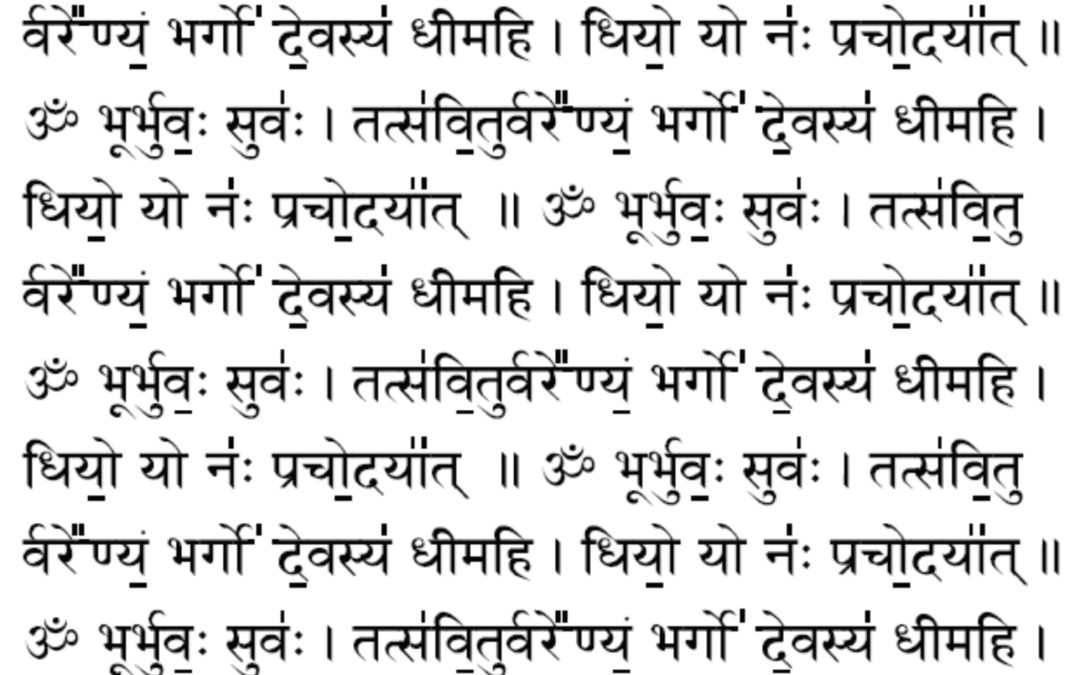
The Gayatri mantra, the most ancient of the mantras found in the Rig Veda, is considered to be the mother of the Vedas. The sound “gai” in Sanskrit means sing and “trai” means protect. Gayatri therefore translates to “she who protects the singer.” The practice of the Gayatri mantra allowed the Rishis, or seers, to receive the revelation of all other mantras.
The Maha Mrityunjaya Mantra
The practice of the Maha Mrityunjaya mantra sends forth vibrations from body to mind to soul. It awakens the internal healing forces and Nature’s healing forces together so that we may receive the full nourishment of any discipline undertaken for well-being. Strengthening the powers of will, knowledge and action, it unblocks the flow of courage and determination.
Yoga and Meditation
by Jennifer French People often wonder what the difference between yoga and meditation is, believing that they are two separate practices. In truth, yoga has a long tradition that is thousands of years old and, originally, its main purpose in practice was to hone and...
The Four Purusharthas: Moksha
The Fourth Aim: Moksha Our investigation of the four Purusharthas, or aims of life in the Vedic tradition, concludes with Moksha, which means release, liberation or self-realization. The harmonious interactions of the first three aims, Dharma, Artha and Kama, are the...
The Four Purusharthas: Kama
The Third Aim: Kama As our investigation of the Purusharthas continues, we come to the third aim, Kama, which means longing, wish, or desire. Kama pertains to the enjoyment of life and needs to be in balance with Dharma (duty) and Artha (means) if we are to experience...
The Four Purusharthas: Artha
The Second Aim: Artha The second Purushartha or aim of human existence as described in the Vedic texts is Artha, which means "wealth," "means" or "goal" in Sanskrit. Artha is kept in check by Dharma. The Purursharthas are not to be considered in a stand-alone fashion....
The Four Purusharthas: Dharma
The First Aim: Dharma The regulating moral principles of the Universe are described in the ancient Vedic texts to be the four Purusharthas, ususally translated as "aims of human existence." Specifically, they are defined as Dharma (duty), Artha (wealth), Kama...
February Yogis of the Month
Miguel and Nicole Dotres The Yoga Sanctuary: Can you tell us a little about yourselves? Miguel and Nicole Dotres: We have been married for 15 years and have 2 children. We moved to Punta Gorda from Miami 3 years ago in an effort to find a great place to raise our...
Sankalpa and the Power of Mars
By Gwen Burdick In Yogic philosophy, when the intention of the heart and intention of the mind merge with resolve and determination in search of Truth, we have what is called Sankalpa in Sanskrit, or solemn vow. “Kalpa” means vow and “san” means truth. It refers to...
How is a yoga therapy session different from a general yoga class?
by Jaime Boswell As yoga therapy becomes a bit more mainstream in the U.S., with yoga therapy schools now receiving accreditation and yoga therapists being certified through the accredited programs, it is a good time to talk about some of the questions that are...
The Transformative Value of Fire Ceremony
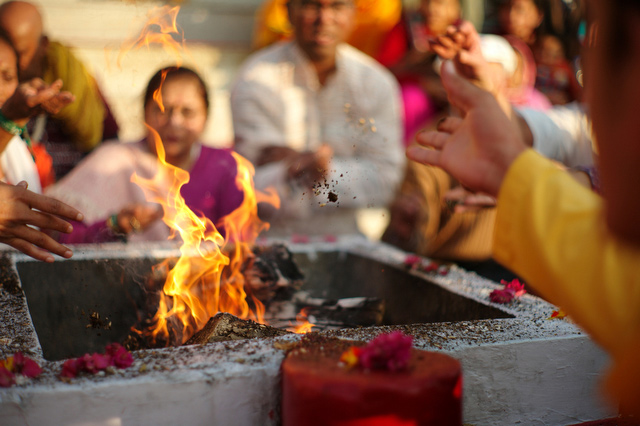
For centuries, fires have been used by ancient and native cultures around the world to create ceremonies. Fire, or Agni in Sanskrit, is a transformational force of purification and creation, and indigenous cultures have been infusing this sacred element with prayers, reverence, and intention as a means to connect with the Divine. Specifically in the Peruvian tradition, fire ceremonies have been used throughout the ages as a means of ritual, celebration and connection with the Universe because of their potent form of prayer.
Yoga Therapy: A Holistic Approach to Self-healing
By Jaime Boswell Yoga Therapy stands distinctly apart from other therapies in that it is based on the application of yoga philosophy through a holistic approach to individuals. Yoga therapy does not take the place of medical treatments. In fact, the yoga therapy...
The Vedic Fire Ceremony
Fire, or Agni in Sanskrit, is one of the five basic elements of creation. It dominates the Pitta dosha of Ayurveda. In its highest expression, Agni is the source of self-discipline, purification and transformation.
Meditation and Restorative Yoga
Complementary Practices to Promote Relaxation and Healing by Melissa Goodwin Students often ask, “What is the difference between meditation and restorative yoga?” This is a great question, because we tend to think of both in terms of the same set of desired results:...
The Myth of RAHU and KETU: the Lunar Nodes
In Vedic Astrology, Rahu and Ketu are the important Lunar Nodes. Unlike the seven visible planets, Grahas in Sanskrit, they are massless yet potent mathematical points in space, sometimes referred to as the shadow planets. Our solar system is structured such that it...
Sister Sciences: Ayurveda and Jyotish
The purpose of the Vedic sciences is to promote Self-realization, and the spiritual disciplines of Ayurveda and Jyotish, Vedic Astrology, share their ancient roots. Ayurveda, which means knowledge of Life in Sanskrit, provides regimens to harmonize the mind/body...
Navrati: The Nine Nights of the Goddesses
October 9th - 18th, 2018 by Gwen Burdick Navratri, a nine night-long celebration of the Divine Feminine, occurs every year on the New Moon in the Vedic month of Ashwin (usually our September, but not always) near the autumnal equinox. Worship of the Goddesses Durga,...
Surya
"The Moonbeams are also the rays of the Sun." - the Vedas Our Sun, Surya in Sanskrit, is the 4.5 billion year old yellow dwarf star at the center of our solar system. It is an almost perfect sphere of gas (mostly Hydrogen and Helium) 860,000 miles in diameter and...